Subterranean termite treatment in Houston requires specific engineering because the local soil profile consists primarily of dense, expansive Beaumont clay overlaid by alluvial silt from the Buffalo Bayou and San…
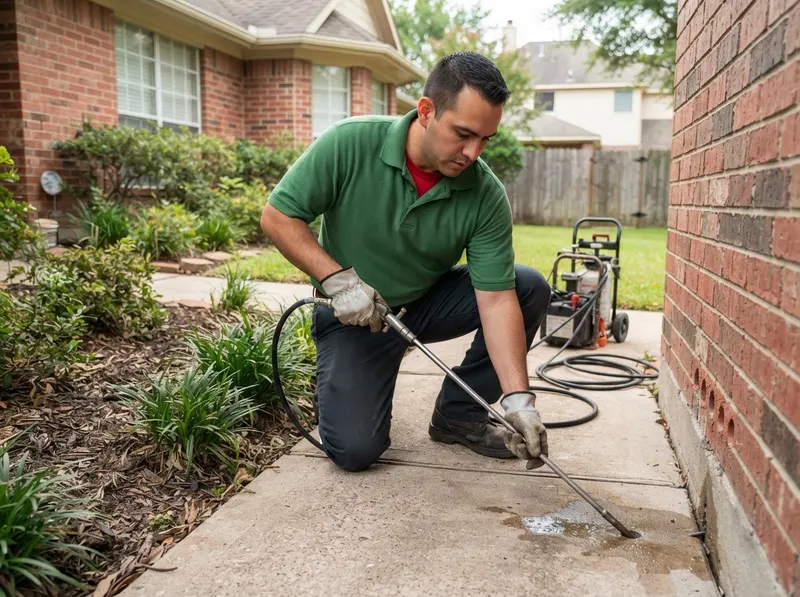
Subterranean termite treatment in Houston requires specific engineering because the local soil profile consists primarily of dense, expansive Beaumont clay overlaid by alluvial silt from the Buffalo Bayou and San Jacinto River watersheds. Subterranean termites construct earthen shelter tubes, known as mud tubes, up exterior slab edges, pier-and-beam footings, and weep holes to transport moisture from the soil into interior structural framing. In coastal Harris County environments such as Clear Lake and Kingwood, high ambient humidity accelerates timber decay, allowing aggressive Formosan termite colonies to establish aerial secondary nests without direct continuous ground contact.
Technicians treat slab-on-grade homes common in Meyerland, Oak Forest, and Memorial by excavating a 6-inch by 6-inch trench directly against the external concrete foundation perimeter. Non-repellent liquid termiticides, such as fipronil, are applied at standard label rates of 4 gallons per 10 linear feet per foot of depth. Workers also drill 0.5-inch holes spaced 12 inches apart through abutting concrete flatwork, including driveways, carports, and back patios, to inject the termiticide directly into the underlying soil matrix. Historic pier-and-beam residences throughout Montrose and The Heights receive complete crawlspace perimeter trenching and localized wood-void termiticide foam injection to protect structural heart-pine subfloors without disturbing native foundation timbers.
1. Technicians conduct a comprehensive tactile and thermal assessment of all perimeter baseboards, crawlspace support piers, and plumbing penetrations.
2. The perimeter soil is trenched down to the top of the footing, preserving adjacent lawn roots and exterior landscape beds.
3. Concrete pads abutting the structure are drilled every 12 inches to establish an uninterrupted sub-slab barrier.
4. Non-repellent liquid solution is metered into the soil trenches at labeled volumetric specifications.
5. Drilled concrete penetrations are backfilled and sealed flush with hydraulic cement matching the existing surface texture.
A complete perimeter liquid barrier fits homes showing evidence of active ground foraging across wide foundation expanses. Direct spot treatment suits isolated outbuildings or contained fence posts, saving structural resources while observing the $250 service baseline. The practical trade-off centers on perimeter continuity: localized treatments leave unprotected slab sections exposed to future foraging, whereas continuous exterior barrier applications require drilling exterior walkways but deliver uniform subterranean defense for 5 to 8 years.
Every job gets a firm, written price after a free on-site visit.
Tell us about your subterranean termite treatment job in Houston and we'll send a clear, written quote, usually the same day.
 Bayou Cedar Pest Control